VOLTAGE AND CURRENT RELATIONS INVOLVING SHORT TRANSMISSION LINES
Labels: Week 09
The course discusses electrical power generation, transmission, and distribution systems for electrical engineering students. It also discusses the principles of AC/DC transmission and distribution system. It deals also with the study of the calculation of parameters, conductor selection and underground power transmission and distribution.
Labels: Week 09
Labels: Week 08
Labels: Week 07
Labels: Week 06
Labels: Week 05
Inductance is the property in an electric circuit where a change in the electric current through that circuit induces an electromotive force(Emf) that opposes the change in current
In electrical circuits, any electric current, i, produces a magnetic field and hence generates a total magnetic flux Φ, acting on the circuit. This magnetic flux, due to Lenz's law tends to act to oppose changes in the flux by generating a voltage (a back EMF) in the circuit that counters or tends to reduce the rate of change in the current. The ratio of the magnetic flux to the current is called the self-inductance, which is usually simply referred to as the inductance of the circuit. To add inductance to a circuit, electronic component called inductors are used, which consist of coils of wire to concentrate the magnetic field.
The term 'inductance' was coined by Oliver Heaviside in February 1886. It is customary to use the symbol L for inductance, possibly in honour of the physicist Heinrich Lenz
The unit of inductance is the henry (H), named after American scientist and magnetic researcher Joseph Henry 1 H = 1Wb/A.
The quantitative definition of the (self-) inductance of a wire loop in SI units ( webers per ampere known as henries is

where L is the inductance, Φ denotes the magnetic flux through the area spanned by the loop, Ni is the current in amperes. The flux linkage thus is is the number of wire turns, and
Taking the time derivative of both sides of the equation NΦ = Li yields:

In most physical cases, the inductance is constant with time and so

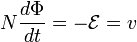
By Faraday's law of Induction we have:

where
is the Electromotive force (emf) and v is the induced voltage. Note that the emf is opposite to the induced voltage. Thus:

or

At extra-high (EHV), that is, voltages above 230 kV, corona with its resultant power loss and particularly its interference with communications is excessive if the circuit has only one conductor per phase. The high-voltage gradient at the conductor in the EHV range is reduced considerably by having two or more conductors per phase in close proximity copared with the spacing between phases. Such a line is said to be composed of bundled conductors. The bundle consists of two, three or four conductors. The three conductor bundle usually has the conductors at the vertices of an equilateral triangle, and the four conductor bundle usually has its conductors at the corners of a square. The current will not devide exactly between the conductors of the bundle unless there is a transposition of the conductors within the bundles, but the difference is of no practical imporatnce, and the GMD method is accurate for caculations.
Reduced reactance is the equally important advantage of bundling. Increacing the number of conductors in the bundle reduces the effects of corona and reduces the reactance. The reduction of reactance results from the increased GMR of the bundle. The calculation of GMR is, of course, exactly the same as that of a stranded conductor. Each conductor of a two-conductor bundle, for instance, is treated as one strand of a two-strand conductor. If we let
indicate the GMR of a bundle conductor and
the GMR of the individual conductors composing the bundle.
For a two-strand bundle
=
=![]()
For a three-strand bundle
=![]()
For a four-strand bundle
![]()
Labels: Week 04
1. To transmit power from water power site to a market. These may be very long justified because of subsidy aspect connected with a project. 2. For bulk power to a load center from outlying steam station these are likely to be relatively short. 3. For interconnection purposes, transfer of energy from one system to another in case of emergency or in response to diversity in system peaks. | |
![]() ![]() ![]() | |


Labels: Week 02
Labels: Week 01
The resistance R of a conductor of uniform cross section can be computed as

where:
For practical reasons, any connections to a real conductor will almost certainly mean the current density is not totally uniform. However, this formula still provides a good approximation for long thin conductors such as wires.
Near room temperature, the electric resistance of a typical metal increases linearly with rising temperature, while the electrical resistance of a typical semiconductor decreases with rising temperature. The amount of that change in resistance can be calculated using the temperature coefficient of resistivity of the material using the following formula:
![R = R_0 [\alpha (T - T_0) + 1]\,\!](http://upload.wikimedia.org/math/b/5/e/b5e510a563967b7edb98ee8e8ed1b280.png)
where:
T is its temperature,
T0 is a reference temperature (usually room temperature),
R0 is the resistance at T0, and
α is the percentage change in resistivity per unit temperature.
The constant α depends only on the material being considered. The relationship stated is actually only an approximate one, the true physics being somewhat non-linear, or looking at it another way, α itself varies with temperature. For this reason it is usual to specify the temperature that α was measured at with a suffix, such as α15 and the relationship only holds in a range of temperatures around the reference.
This table shows the resistivity and temperature coefficient of various materials at 20 °C (68 °F)
Material------- Resistivity (Ω·m) at 20 °C----- Temperature coefficient* [K−1]
Silver------------ 1.59×10⁻⁸-------------------------------- 0.0038
Copper--------- 1.72×10⁻⁸-------------------------------- 0.0039
Gold------------- 2.44×10⁻⁸-------------------------------- 0.0034
Aluminium----- 2.82×10⁻⁸-------------------------------- 0.0039
Calcium-------- 3.36x10⁻⁸
Tungsten------- 5.60×10⁻⁸------------------------------- 0.0045
Zinc-------------- 5.90×10⁻⁸------------------------------- 0.0037
Nickel----------- 6.99×10⁻⁸
Iron-------------- 1.0×10⁻⁷---------------------------------- 0.005
Platinum------- 1.06×10⁻⁷-------------------------------- 0.00392
Tin--------------- 1.09×10⁻⁷-------------------------------- 0.0045
Lead------------ 2.2×10⁻⁷---------------------------------- 0.0039
Manganin----- 4.82×10⁻⁷-------------------------------- 0.000002
Constantan---- 4.9×10⁻⁷--------------------------------- 0.000 008
Mercury-------- 9.8×10⁻⁷---------------------------------- 0.0009
Nichrome[6]-- 1.10×10⁻⁶--------------------------------- 0.0004
Carbon[7]----- 3.5×10⁻⁵--------------------------------- −0.0005
Germanium[7]-- 4.6×10⁻¹------------------------------- −0.048
Silicon[7]------ 6.40×10⁻²-------------------------------- −0.075
Labels: Week 03